Saturday, November 9, 2024

OPEN LETTER AGAIN -- To Cities, States, Law Enforcement Agencies and their Individual Personnel DO NOT PARTICIPATE _IN ANY WAY_ IN MASS DEPORTATION OPERATIONS


Brothers and sisters, fellow Americans,

Eight years ago, in the days after the first election of Donald Trump as President, I wrote a similar open letter asking that state and local officials, their law enforcement agencies and if need be individual law enforcement officers refuse to participate _in any way_ in mass deportation efforts that may be demanded of them by the incoming Trump Administration, not even in providing “crowd control” while other, federal, agents / units did the actual arresting and taking away of undocumented individuals. 

I noted then that one of the less talked about horrors of the Holocaust was that the Nazis generally forced the local law enforcement agencies to do the initial dirty work for them, notably that Paris’ Jewish community was rounded-up by Paris’ own police force under, of course, the occupying authorities’, the SS’s, supervision.  Even then a fair number of local police officers “called in sick” in those times in order to avoid participating in such moral horrors.

While we are being told that “the initial wave” of arrests in the now more certain wave of mass deportation promised by the returning Trump administration will involve “only criminals,” there is SIMPLY NO WAY that ANY OF US CAN BE CERTAIN THAT THIS WILL ACTUALLY BE THE CASE, and this goes for the local law enforcement officers who will be asked to participate or otherwise support such a task.

Further it’s a more or less clear “shell game” / “bait and switch.”  While _some_ officials talk of deporting “only criminals” others ENTHUSIASTICALLY (including U.S. Senators) talk of “arresting and deporting ALL ‘illegals.’”

I CAN TELL EVERYONE WITH 100% CERTAINTY that if the mission becomes deporting ALL undocumented persons in this country, then our nations’ law enforcement agencies will be asked to collaborate in the kicking down of doors and arresting otherwise smiling, rosary in their hand praying, happily-from-ear-to-ear tamale (or perogi, or pansit) making grandmothers.   They will also be arresting honest, 16-hour a day, EVERYDAY, hard working family men and women who are here only because they were guilted to do so by their families asking that they “man up” (!) and do what every other young man or woman of worth in their village had also done to support their families – to come here. 

As such, our nations’ police and perhaps military are going to be asked to arrest and destroy MANY, MANY Holy Families. 

To this I PRAY NO !!

So I again ask the nation’s major cities and states to REFUSE TO COLLABORATE _in ANY WAY_ with ANY Mass deportation operation ordered by the returning Trump Administration. 

I further ask that INDIVIDUAL MILITARY AND LAW ENFORCEMENT PERSONNEL utilize their RIGHT TO SELECTIVE CONSCIENTIOUS OBJECTION articulated in the U.S. Catholic Bishops’ 1983 Pastoral Letter “The Challenge of Peace” to individually NOT PARTICIPATE in such operations.

As I wrote 8 years ago, there are only so many otherwise smiling rosary praying grandmothers that one can arrest, only so many children weeping for their papi and mami that one can watch, before this nightmare necessarily changes one. 

Arnald Schwarzenegger, an Austrian immigrant to this country and child of post-war Austria has repeatedly talked about the AWFUL SILENCE that he heard from his father’s generation about what they did in the war, because they were ashamed.

Please DON’T DO THIS TO YOURSELVES, DON’T DO THIS TO YOUR OWN CHILDREN.  Stop.  DON’T PARTICIPATE …

In the name of Almighty God and all that is GOOD, do not embark on this path,

Sincerely and in Christ, who himself was a refugee,


Fr. Dennis Kriz, OSM, 

Pastor, St. Philip Benizi Parish,

Fullerton, CA


Sunday, March 13, 2022

An Open Letter to President Vladimir Putin -- Become Vladimir the Good by Stopping this War in Ukraine

Dear Vladimir Vladimirovich Putin, President of the Russian Federation,

I WRITE TO YOU today in a manner that perhaps I was destined to do all my life:

You see, one of my earliest memories was when the Soviet Union invaded my parents' country, Czechoslovakia on my mother's birthday.  I was 4 years old at the time.  These kind of memories, her face, stay with one all one's life.

I'm also named after an uncle of mine on my father's side who, the first one in his family to make it to the University, was arrested and imprisoned for being part of a student group which passed around, at that time, the 1950s, literature that the Communist authorities had considered subversive. 

Finally, on my mother's side, my grandfather (deduska) was Russian, actually and fascinatingly here 1/2 Russian and 1/2 Ukrainian.  His mother was Russian, his father Ukrainian.  My deduska was born and grew up in Mineralnye Vody "na Kafkazu" (in the Caucuses)  

He too as a young person had to run for his life during the time of the Russian Civil War, actually himself running from the Whites because he wrote into the local newspaper of the time a complaint asking why the White Guards had hung two of his best friends in the town square.  He was told by another friend that he had to leave town immediately or else he'd be hung next to them.  

That was the last time he saw his parents and family, who died in the famines that killed so many Ukrainians and one of the main reasons why the Ukrainians so want to be independent from Russia even today.

So I understand the youth of your country, the youth my country, when we get upset at strong men doing terrible things to people who honestly don't deserve to suffer or die.


BUT I ALSO WRITE as one who understands your central complaint against the West.  I too know _well_ the Western prejudice against Russians (and Slavs in general, but I'm going to write here specifically of Russians) who despite a 1000+ year history and a culture, religion, arts and music that can hold their own against any other and yet are ignorantly and arrogantly dismissed by people who don't even know what they themselves lost from their own cultural pasts.  I completely understand your complaint against the West.

And yes, I even celebrate the achievements of the Russian space program, who with ingenuity, improvisation, optimism and will, were able to achieve matters that the often perfectionist, petty and egotistical West was unable to do.


HOWEVER, FINALLY I WRITE TO YOU as a religious man:  I grew up in a family where all three major branches of Christianity were present -- Catholicism, Protestantism and through my mother Orthodoxy.  

I am a Catholic priest for reasons too complex to explain here, but I do know a fair amount about Orthodoxy both much of the good and some that could, with humility, of course, be improved.

I know for instance that the Orthodox Patriarch of Moscow will NEVER tell you what to do.  In the Orthodox conception, you are in power because God wills it.

But why God wills that you be in power, is then for your humble discernment, and though the Orthodox Church would NEVER tell you why, the reasons _may not be_ for the ones that you may think you are in power.

For instance, if you stopped this War in the Ukraine, if you humbly admitted that despite your best intentions for the sake of Mother Russia and the Right Faith, you made a mistake,  THE ORTHODOX CHURCH WOULD PRAISE YOU TO THE HIGHEST HEAVEN AS THE GREATEST (RUSSIAN) LEADER WHO EVER LIVED.

Take a moment to reflect on this and YOU'D KNOW THAT THIS WOULD BE TRUE.

You would become a Saint.  Churches 500 years from now would be built in your honor.  

You would become known as St. Vladimir the Penitent, the Humble, the Good.  

500-1000 years from now, your name would be praised as a leader who despite having all the power in the world at your disposal (and all the temptations that come with it) that you realized that you had made a mistake, that despite your intentions you were hurting the innocent.

With the Patriarch of Moscow, smiling and praising you at your side, HE would forgive you, YOUR PEOPLE would forgive you.  

Even the Ukrainians, relieved that they'd be allowed to live, would honestly grudgingly forgive you, and a case would be made in their history for the next 500-1000 years that: 

"You know what, the Russians weren't all that bad.  This St. Vladimir COULD HAVE CRUSHED US, and after seeing how things were going, HE REPENTED OF IT and let us live.  What an amazing leader he turned out to be."

This is possible Vladimir Vladimirovich.

And in as much as possible, I, along with certainly many others, would be willing to do anything, to make it possible for you.  

Think of the people that you could let live.  Think of the example that you could give to leaders ALL OVER THE WORLD for the next 500, 1000, 5000 years from now.

You could become truly Great by becoming above all Good.

And the WHOLE ORTHODOX CHURCH would bless you for it.

Slava Russye, Slava Ukrainye, and above all Slava Bogu.

Sincerely and in Christ,

Fr (Batuska) Dennis Zdenek Kriz, OSM
Friar Servant of Mary

Saturday, January 22, 2022

The Czech card game of Mariáš

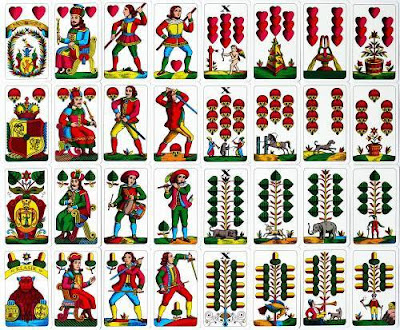
During my recent week of Covid (Omicron) isolation, I took the opportunity to relearn a Czech card game called Mariáš.  The game must go back to the Middle Ages even though it remained an staple of Czech and Slovak tavern life through the centuries and even to this day.   The cards themselves are spectacular:

The game had been originally taught to me and my cousins by our uncle Zdeněk of very happy memory.  He died at 90 just before the COVID curtain had come down on the world.   Presently, my last trip to the Czech Republic was, in fact, in January 2020 for his funeral.

We all grow and we all lose things of our past.  But losing memory of how to play this game -- I still have a deck of cards for it – and even more, not really having anyone certainly nearby to play it with, produced a fair amount of sadness in my heart.   

So as I looked for things to keep myself busy during my COVID isolation, I thought to relearn this game and see if someone had come up with a way that one could play the game virtually, and perhaps even over Skype or Zoom.

It turns out that there are a number of Apps for both Apple and Android phones that allow one to play Mariáš against two AI opponents.   And talon.cz offers one the opportunity to play it against other living opponents at virtual tables.

Alas the apps are only available in Czech.  I even wrote to the writer of one of the Android apps if he had any plans in making the game available in English.  He wrote back saying that given the number of interested parties who’d want the game in English would probably number “in the dozens” he didn’t think it worth his time.

However, it occurred to me that a simple explanation and glossary would probably make it sufficient to allow English speakers to play the game on the aps available.

An Explanation of the Rules of the Game

An truly excellent and much more thorough English explanation of the game is offered here.

The Card Deck

The Mariáš Card Deck is composed of 32 Cards (Seven to Ace) in Four Suits:

Červený or Srdce (Red or Hearts)

Zelený or Listy (Green or Spades)

Kule (Bells or Orbs)

Žaludy (Acorns)

The Cards then portray: 

Eso (Ace), Král (King), Svršek (Over-Knave), Spodek (Under-Knave), 10, 9, 8, 7

Play

Mariáš is normally a three-player bidding game where two players play together against the one who calls the game.

Cards are passed out in the following manner:

Seven cards, face down, are passed to the player who will have initiative to call the game. After looking at the cards, he will have to set aside a card, still face down to the others, to declare a trump suit. 

The remaining cards are passed out, in groups of five cards, first to each of the other two players, then to the player who will have initiative to call , and back to the other two players. 

The players can then can look at their cards.

Note that the player with initiative will have two extra cards, so he will have to discard of two of the cards, face down to the other two players, before bidding begins.

At this point he calls the game.

The simplest game is called Barva (suit), in which he calls the trump suit (červená, zelená, kule, žaludy).

He can also call one of several other games:

(1) Betl -- If he has a lot of low cards, he can call a game called betl, in which he promises to lose every trick when play begins.

(2) Durch -- If he has a lot of high cards, he can call a game called durch, in which he promises to win every trick when play begins.

(3) Sto -- If he has a lot high cards especially in his trump suit, a „marriage or two“ (more on that below when we get to scoring), he could call „sto“ (one hundred) in which he promises to make 100 points with his hand after play begins.  (Scoring is explained below).

(4) Sedma -- If he really has a lot in his trump suit, including the seven (the lowest) card in the trump suit he could call „sedma“ in which he promises to end and win the last trick in the hand with the seven in the trump suit. 

After calling the game, bidding goes to the other two players.

They each can respond:

(1) Dobrá“ which means „okay.“  However, if both respond this way without challenging him with a flek (see below), the game is forfeited to the player with initiative. 

(2) Špatná” which means “bad” or “no” in which the player declaring it so, declares that he’s going to play a higher stakes game.  

The stakes go as follows – Barva (color), Červená (Red color), Betl, Durch.  So if one of the two opponents goes this route, he must pick a higher stakes game than the one declared by the player with initiative. 

After declaring “špatná,“ that is to say declaring that he is confident that he can play and win a higher stakes game than called, that person takes the two cards that were discard by the person who had previously had initiative.  He looks at his hand and discards, again face down, two cards (they could be the same ones, or could be different) in their place, and declares the new game.  Bidding starts anew with this new person having the initiative.

(3) “Flek” which means that the person is confident that he (along with his partner) will be able to beat the person with initiative at the game that the person with initiative had declared.

(4) Counter “100” / “sedma” if the person is confident the that person with initiative has really called the wrong game.  

Note that this can happen with some frequency as the person with initiative must declare suit looking at only 7 cards (without seeing the other five cards to be dealt to him).

So one or another of the persons playing against the person with initiative could bet that not only that the person calling the game will (1) lose, (2) but loose big (that his opponents will score at least 100 points together against him) or that (3) the person has so few trumps that the person calling this challenge will actually win the last trick with the trump suit's 7 card. 

(5) After someone calls “Flek” against the person with initiative, the person with initiative, if confident in winning the hand that he’s declared can “double dare” by calling “Re.”  The third player can double the stakes again by calling out “Tutti” and person with initiative can double the stakes again by calling out “Frutti.” One of the others can double again by calling out “Boty” (shoes), another “Kalhoty” (pants) and finally “Až pod stůl” (“all the way under the table).  

So occasional bidding wars can become quite amusing!  With each challenge, and counter challenge the stakes in the hand double.  So by the time one goes to “až pod stůl” one will have “bet the farm,” though the image here would be of betting all one’s clothes (only figuratively), so as to have to hide under the table if one loses!

Scoring (and winning / losing) a Hand 

In normal play (barva, sto, sedma):

In normal play, only the Aces and 10s count for points – 10 pts each – An Ace beats a 10, 10 beats everything but the Ace.   Additionally, the winner of the final trick in a hand wins 10 points.  So the basic number of points in a hand is 90.

However, there are also Marriages (from hence the game's name Mariáš probably originates).

If a player is dealt a Král-Svršek (King-Over Knave) pair in the same suit then he has been dealt a "Marriage," which he can declare, usually by playing the lower Svršek (Over Knave) card during the course of play.  Marriages in non-trump suits are worth 20 points, Marriages in the trump suit are 40 points. 

Note that while one can both have one's Aces and 10s captured by one's opponent(s) (or one can strategically play them over to one's partner) in the course of play (see below), the points for Marriages stay with the player (or side) who plays them.

So the total number of points that is possible in a hand can run as high as 190 (ninety points due to Aces / 10s and winning the last trick, and up to 100 points potentially available due to Marriages).  This is why, if one has a lot of high cards and Král-Svršek pairs, one can declare and seek to win a "sto" (or hundred point) hand. 

At the end of the hand, the number of points (between Aces, 10s and declared Marriages) held by the person who called the game are compared to the sum of the points (between Aces, 10s and declared Marriages) held by the other two players.  The one (or the opposing team) with the higher number of points wins.  

If a Sto (hundred) game had been declared by either side, that is measured as well.  If one met or exceeded the goal then one has won, if not then one has lost.

If one (or the opposing team) had declared a Sedma (ending with winning the last trick with the seven of the trump suit) game, and one succeeded in doing so, then one won that aspect the game, if not, then one lost.

If there is betting on the game (see below), if the person who calls the game wins, then he wins the total of the winnings. If instead, the team of other two playing against him wins then the winnings are split by the by team.

Betl (Low) and Durch (High) Games.

Betl (Low) and Durch (High) Games, points are no longer counted, the 10 returns to its normal place in the order of the deck, beating a nine and losing to a spodek (lower knave).  All that matters in these games is that the person declaring the game either loses (Betl) or wins (Durch) all the tricks in the hand.  If he does so, he wins the hand, if he does not he loses it.

Playing out the Hand

Understanding now how the scoring goes in the course of a hand, let's now explain how the hand is played out:

The first trick is initiated by the person who called the game followed by the others in clockwise fashion.   The winner of each trick initiates the next trick

In each trick, each player must try to both honor and beat the previous person's card in suit.

If one can't beat the previous card in the suit initiated but still has cards in that suit, one must still honor the suit by playing a lower (yet losing card in that suit).  

If one has run out of cards in the suit initiated in the trick, one must try to play a trump card.

If as the third player in the trick, one has run out of cards in the suit that initiated the trick, and the second player in that trick also has run out of cards in that suit (and has thus played a trump card in its place), then one must try to beat the previous player's trump card with a higher valued trump card.

If as the third player in the trick, one still has cards in that suit, but the second player not having any more cards in that suit has played a trump card, then one still must honor the original suit (even if that means one has to play a 10 or an Ace, hence losing those points).

If a player no longer neither has cards in the suit that initiated the trick, nor any more trump cards, then one can dump whatever card that one wishes.  (Note that there's some strategy here.  One can try to dump point cards to one's partner if one thinks that one's partner is going to win the trick.  Alternatively one may wish to conserve one's point cards in hopes that one's opponent or opposing side will no longer have the cards or trump cards to take them away at a later stage in the hand).

When all the cards are played, the points held (between aces, 10s and declared marriages) by each of the players is determined and the point totals of the two people playing against the person who called the game are added together, and the winner (see above) determined.

The cards are then brought together (but not shuffled, though the person receiving the first card in the next hand can cut the deck) and the cards are distributed in the next hand.

Playing for money / keeping a Tab

The base value of winning a Barva hand is 1 Kč. (1 Crown)

A flek doubles the stakes of the hand.  Any further doubling "Re", "Tutti", etc further increases the stakes of the hand.

The base value of 100 hand is 2 Kč.

The calling a "sedma" (closing the hand by winning the last trick with 7-trump suit) adds 1 Kč to the stakes (this can be presumably "fleked" as well)

The base value of Betl hand is 5 Kč.

The base value of a Durch hand is 10 Kč.

Note again that if the player who calls the hand wins, the winnings go entirely to him.  If on the other hand he loses, the winnings are split between the two players who beat him.

A tab is kept throughout the course of the play to determine who is up or down.

Note that this really isn't a game that is generally played for a lot of money.  Instead, this is a social game, played in a pub among friends over the course of a fairly long evening.

Friday, December 31, 2021

On the Czech King Přemysl Ottakar II the Stubborn / Arrogant but certainly Brave


Here is a great picture of Premysl Ottakar II one of the most important kings of Bohemia (Czechia) painted by Karel Řepka and posted on the FB group "Český Středověk" (the Czech Middle Ages).

Yes the Czechs had once been a kingdom.  Bohemia (Czechia) had become one of the six elector states of the Holy Roman Empire. Here Ottakar II thought that since his kingdom had become the most powerful kingdom of the H.R. Empire of the time, that he should be elected Holy Roman Emperor. Instead precisely because he was pretty powerful, the other Electors chose to elect a young upstart named Rudolph of Habsburg (the weakest among them) who was a mere Duke at the time to be Holy Roman Emperor.

 Ottakar II got angry, went to war against Rudolph as well as the other elector States of the H.R. Empire and ... died on the battlefield in the "Battle of the Moravian Fields." and history was largely written from there. The Habsburgs came to be one of the most powerful and longest lasting dynastic families in European history with their falling from power only in 1918 nearly 650 years later.

The Czech Premyslid dynasty came to an end though Ottakar's daughter Eliška (Elizabeth) married a young John of Luxemburg who became then the Czech king (King of Bohemia/ Czechia) and his son Karel (Charles) was laterelected as Charles IV as Holy Roman Emperor in the 1300s. Charles IV built (or completed the famous Charles Bridge in Prague as well as founded the famous Charles University in Orague, the oldest university in central Europe.

One thing that I like about the marriage of John of Luxemburg and Eliška of the Premyslids was that it consolidated the two greatest beer drinking peoples under one roof . And perhaps that was "an attraction" for (as remembered by the Czechs) the famously boisterous King John of Luxemburg who like Premysl Ottakar II (pictured here) eventually died in battle: 

With some battle somewhere beginning to go badly John of L was to have said: "Far be it for a Czech king to run from a battlefield..."

Course perhaps the other kings of the time and times since may have learned something from the examples if Ottakar II John of Luxemburg ... you can't continue to rule if you're dead.

Still leading from the front seems far more inspiring than from the back.

Say what one will of Napoleon. He understood that too. While he did not die on the battlefield, he didn't ask his people to go where he wasn't willing to go himself. He went with his troops all the way to Moscow and later was captured with his troops at Waterloo.

Anyway all thus from a picture of a (to us) famous Czech king from the 1200s.

One final note Dante refers to Ottakar II / Rudolph of Habsburg in the Divine Comedy (Purgatorio Canto 7) He has the two _reconciled_ singing in choir (with the other Kings of history) in front of the Door to Purgatory waiting for all the other souls to pass to fulfill Jesus' saying:

"The first shall be last and the last shall be first" (Matt 20:16)

And final PS -- It turns out that Premysl Ottakar II was born in the same year as St Philip Benizi / the founding of the Servite Order ... 1233 ...


Wednesday, September 29, 2021

On a Modern Day Mystery - "The Viking of Prague"


About a year ago, a fellow American Servite gave me an article about the discovery of the tomb of a  “Viking” under Prague’s Castle in the 1920s.  I’ve since lost that article but have been interested in the story ever since.

The story shows up occasionally, both the English and Czech press, in good part because it’s fascinating: What was he doing there?

There’s a Wikipedia article about it: https://en.wikipedia.org/wiki/Prague_Castle_skeleton

The most extensive recent article about it in English was written by Nicholas Saunders, Jan Frolik and Volker Hold in Antiquity 39 370(2019): 1009-1025.  

The article was quite good, suggesting at the end that he was probably Nordic, but that at the time, he might not have considered himself as such, or was simply a mercenary or adventurer, who nonetheless was prominent enough to warrant the kind of burial that he had received, at a time, incidentally either before or just after the foundation of Prague’s castle.    

Looking up / following some of the links / references made in both the Wikipedia and Antiquity article, I wrote then the principal author asking him if this “Viking” would be considered something of a 9-10th century “Heydrich” figure.

My argument was this: 

(1) It is attested in the Fulda Annals of the time (attn non-Czech readers, just use the “translate option” on your web-browser to have the various pages here translated into English) that throughout the period in question, Bohemia and then certainly Central Bohemia was already clearly Slavic, though Bohemia was contested territory between the Frankish Germans to the West and the Slavic Moravians to the East, and pretty much every year the Frankish king sent out an expedition to Bohemia to plunder or otherwise extract tribute.  

(2) In 872 there appeared to be indeed, a famous battle “U Vltavy” [FA] [Wikip]  where a Frankish expedition took on five Czech Princes and possibly a sixth named Gariwey (Bořivoj?).  That Frankish expedition apparently successfully scattered the Czech princes, but after the princes fled to their citadels the Frankish expedition was unable to do more … and subsequently went home. 

Okay, I suggest that (1) _perhaps_ the encampment of the 872 Frankish expedition was on the _up to then uninhabited hill_ on which today's Prague Castle stands (it would seem like an obvious, strategically useful place to setup such an encampment), (2) after waiting some time for the Czechs to surrender after “scattering them at the Vltava,” THE COMMANDER of that expedition DIED either of battle wounds or simply disease, and (3) the Frankish expedition built him a nice “hero’s tomb” there on the hill and … went home. 

Indeed, if one understands the Fulda Annals correctly, raiding Bohemia to plunder and then going home seemed to be the “modus operandi” of the Frankish Germans vis-à-vis the (Slavic) inhabitants of Bohemia of the time.

Subsequently (4) good old Bořivoj the first historically attested to member of the Premyslid (subsequent Czech royal) dynasty, its first Christian leader (certainly St Ludmila his wife was already baptized), and the traditional founder of the Hradcany Castle, _perhaps_ noting the success of building good strong citadels against Frankish incursion, (a) left his existing citadel of Levý Hradec to the Hradčany site, (b) built (or improved) the wall around it, (c) built a nice church dedicated to St. Mary _near_ but _not_ on top of the tomb of the “Viking” / Frankish warrior, and (d) left the tomb untouched so as to both _not provoke_ the Frankish king but also to put the tomb  “under his protection” and thus … beginning the history of Prague’s castle.

 The advantage of this explanation for the presence of the “Viking” at Prague’s castle would be that it would respect the history of region – that it was already Slavic dominated at the time – and yet explain “the Viking’s” presence.  What was he doing there?

 Linking him to the Battle at the Vltava of 872 would explain both the tomb's presence in the midst of a land that was otherwise not Nordic or Germanic or no longer Nordic / Germanic at the time.  

Friday, January 8, 2021

Coda (I hope :-) on the Presidency of Donald Trump

Obviously, I've never been a fan of Trump AS PRESIDENT [1] [2] [3] [4]. To be honest, I kinda liked his show The Apprentice. I'd _never_ fire people like he did, and never have, but I liked the show. But as a leader, from day one he seemed TO ME to be of the Mussolini mold.
Anyway, attached here is IMHO the best article about Trump's dictatorial ambitions. Put bluntly, the OpEd author wrote that Trump was simply _too lazy_ to be a dictator. The closing paragraph reads:
"Subverting democracy requires more effort than Trump is willing to exert. He wants to be a dictator, but he’s unwilling to do the work to become one. Just as he inherited a fortune, he wants to inherit an autocracy. To be a successful strongman, you need a strong work ethic. Trump has only weak ethics."


Indeed, this Wednesday as he was psyching up his people for his "Beer Hall Putsch" (without even providing the beer...), he told the people, "And I will be there with you." NO HE WASN'T. Was it too far? Was it too cold? Was he just lazy? He just went in and watched it all on TV.
The John Coleman character in the "Big Lebowski," shocked that his friend's rug was pissed-on by Nihilists ("They don't believe in anything") rather than Nazis, said "Well, I'll be damned, say what you want about the tenets of National Socialism, at least it was an ethos."
Anyway, thankfully it's all coming to an end -- still 5 people died -- without the costs being worse.
Oh yes, and then there's the 350K people who died here of the Coronavirus, while everywhere else, things have been led much better than here. But again, it honestly could have been worse.

Saturday, September 19, 2020

On the Death of Supreme Justice Ruth Bader Ginsburg

Ruth Bader Ginsburg was a tireless defender of equal rights for women.  She moved our nation incredibly forward in making us "a more perfect union."  

Her passing will now force a new generation forward to take up the question of abortion, a true Gordian knot, which pretty much all sides understand to tragically pit mother against child.  

The truths on both sides will remain, as they have since Roe v Wade, for a new generation (or generations) to try to successfully resolve: 

Abortion kills children in the first, most defenseless, stages of life.  Yet eliminating abortion will require _convincing_ women who didn't necessarily want the children conceived (for any number of reasons), and may have been _raped_ to conceive them, to bring those children to term.   

I've chosen the word _convincing_ rather than _coercing_ as a means of perhaps moving the question forward.  

Convincing _could involve_ finally providing universal access to affordable health care (and day care) to all people in the United States.  And even in the extreme cases of rape and incest, the idea could be explored (among certainly many others) of offering _generous financial rewards_ (reparations) to women who were raped but nevertheless brought the children conceived to term.  

It should be possible to map out a way to confront the question of abortion in a way that does not return women to second class status which no people of conscience, _including the Catholic Church_, would accept.  But we'll certainly have to become creative.

Saturday, August 15, 2020

I WILL VOTE

Please share.

I WILL VOTE

President Trump has decided to try to defund the U.S. Postal Service (!) in hopes of keeping his opponents from voting BUT I PROMISE TO VOTE.

I will google "register to vote" to make sure I'm registered. I will register if I am not AND I WILL VOTE.

I will go to my assigned polling place AND I WILL VOTE

I will wear a mask, I will wear gloves, I will socially distance, I will stand in line FOR HOURS if I have to BUT I WILL VOTE.

If someone spits at me, coughs at me or laughs loudly in my face, I will brush their spit off of me, wash my face when I get home, take a shower if I have to when I get home BUT I WILL VOTE.

And yes, if I catch the coronavirus, if I die as a result of going to vote, I WILL BE PROUD as I will have "given the last ounce of my devotion" TO MY COUNTRY THAT I LOVE.

As I learned as a school child, I will proudly sing IN MY HEART _every day_ UNTIL ELECTION DAY

My country, 'tis of thee,
Sweet land of liberty, of thee I sing;
Land where my fathers died,
Land of the pilgrims' pride,
From every mountainside let freedom ring!

LONG LIVE THE UNITED STATES OF AMERICA !

Wednesday, July 8, 2020

ANALYSIS OF BLACK LIVES MATTER’S MISSION STATEMENT / ORIGINS STATEMENT

From 2019 -- Fr Dennis, second from left, with members of the homeless community then sleeping at the outskirts of his parish of St. Philip Benizi in Fullerton.

By Fr. Dennis-Zdenek M. Kriz, OSM – July 8, 2020

Fr. Dennis was the chair of the Friar Servants of Mary, USA Province’s Justice and Peace Committee, 2000-2006, as well as member of the Friar Servants of Mary order-wide Secretariat for Justice, Peace and Care of Creation from 2007-2013.  In recent years, in addition to having been an all but immovable defender the dignity of Immigrants (a son of Czechoslovakian immigrants himself), often of color, he has become an outspoken defender of those people who find themselves homeless in Orange County, CA.

Common Americans, and specifically common American Catholics, have been aggressively targeted in recent months by various “authorities” seeking to scare them about “the dangers of the Black Lives Movement” often simply referred to as BLM (quite possibly to avoid having to admit that BLACK LIVES do MATTER…).

Tired of such nonsense that fundamentally MISSES THE POINT – Black people are being KILLED in the United States FOR TRIVIAL THINGS, certainly NOT WARRANTING _DEATH_ -- I’ve decided to provide this analysis of the Black Lives Matter mission statement and statement on its origins to set minds at ease.

(1) Black Lives Matter, BLM, has been accused of being Marxist and pro-abortion.

Yet scanning for the following terms -- marx, marxism, abortion, choice, choose – yield NO RESULTS on both their “What we believe” and “Herstory” (origins) pages (scan for them yourselves).


So … unless ANY statement about justice / injustice is by definition “Marxist” this is just a typical dismissive accusation made routinely against ALL movements that try to bring greater justice in the world.  Martin Luther King, Jr and Nelson Mandela as well as their organizations, the Southern Christian Leadership Conference and the African National Congress (ANC) were in their time accused of the same.


Indeed the BLACK LIVES MATTER, BLM, movement sees itself as one of solidarity rather than “defeating enemies”


“Every day, we recommit to healing ourselves and each other, and to co-creating alongside comrades, allies, and family a culture where each person feels seen, heard, and supported.

“We acknowledge, respect, and celebrate differences and commonalities.

“We work vigorously for freedom and justice for Black people and, by extension, all people.

“We intentionally build and nurture a beloved community that is bonded together through a beautiful struggle that is restorative, not depleting.”

MY THOUGHTS …

“A BEAUTIFUL STRUGGLE that is RESTORATIVE, NOT DEPLETING …” unless _any_ struggle is _by definition_ Marxist (was the American Revolution Marxist? Was the Solidarity Movement in Poland, Marxist?) while the adjective “beautiful” seems to “protest too much”, the “restorative, not depleting” qualifiers indicate that the purpose is not to destroy but rather to build, expand, to set more / all people free.  It’s hard to find fault in that …


(2) Black Lives Matter, BLM, has been further accused of being “radical” / “radical feminist,” “pro-trans” and against “traditional” (nuclear) family. 

Relevant passages on their “What we believe” and “Herstory” pages would be:


“We are unapologetically Black in our positioning. In affirming that Black Lives Matter, we need not qualify our position. To love and desire freedom and justice for ourselves is a prerequisite for wanting the same for others…

“We are guided by the fact that all Black lives matter, regardless of actual or perceived sexual identity, gender identity, gender expression, economic status, ability, disability, religious beliefs or disbeliefs, immigration status, or location.

“We make space for transgender brothers and sisters to participate and lead.

“We are self-reflexive and do the work required to dismantle cisgender privilege and uplift Black trans folk, especially Black trans women who continue to be disproportionately impacted by trans-antagonistic violence.

“We build a space that affirms Black women and is free from sexism, misogyny, and environments in which men are centered.

“We practice empathy. We engage comrades with the intent to learn about and connect with their contexts….

“We foster a queer‐affirming network. When we gather, we do so with the intention of freeing ourselves from the tight grip of heteronormative thinking, or rather, the belief that all in the world are heterosexual (unless s/he or they disclose otherwise).

“We cultivate an intergenerational and communal network free from ageism. We believe that all people, regardless of age, show up with the capacity to lead and learn.

“We embody and practice justice, liberation, and peace in our engagements with one another.”


“As organizers who work with everyday people, BLM members see and understand significant gaps in movement spaces and leadership. Black liberation movements in this country have created room, space, and leadership mostly for Black heterosexual, cisgender men — leaving women, queer and transgender people, and others either out of the movement or in the background to move the work forward with little or no recognition. As a network, we have always recognized the need to center the leadership of women and queer and trans people. To maximize our movement muscle, and to be intentional about not replicating harmful practices that excluded so many in past movements for liberation, we made a commitment to placing those at the margins closer to the center.”

MY THOUGHTS:

So Black Lives Matter (BLM) is not so much “pro-trans” or “pro-radical feminist” as the past / current society has been (quite radically) ANTI-trans, ANTI-women, insisting on their staying in their place, insisting on their marginalization.


“We make our spaces family-friendly and enable parents to fully participate with their children. We dismantle the patriarchal practice that requires mothers to work “double shifts” so that they can mother in private even as they participate in public justice work.

“We disrupt the Western-prescribed nuclear family structure requirement by supporting each other as extended families and “villages” that collectively care for one another, especially our children, to the degree that mothers, parents, and children are comfortable.”

MY THOUGHTS:

Here it needs to be said that the “nuclear family” as we know it came to be, in the West, only after the introduction of Social Security in the U.S. and equivalent programs elsewhere.  That is, until the 1930s ALL FAMILIES EVERYWHERE were “extended families” because most older people had _no means of providing for themselves_ except depending on their adult children.  And even today, many/most poorer families remain organized as Extended Families, where “auntie or grandma” fullfill the role of “day care” that richer families are able to pay for elsewhere.

Further, until a generation ago, the sense of community / neighborhood was near universal.  EVERYONE still growing up, up-to the 1960s had stories of “the mother’s CIA” in which one did something even blocks away from home and by the time one got home, mom was waiting at the door to discipline said kid, because news already reached her via this neighborhood network of “mom’s CIA.”  Only in recent decades did we come to the point where people don’t know their own neighbors.

So BLM here is actually refreshingly _restorative_ not “radical.”


MY CONCLUSION:

All in all BLACK LIVES MATTER is being unfairly besmirched for speaking Truth and seeking to make society better for all.  


ADDENDUM (July 10, 2020) -- 

I find it simply absurd to focus on the hyperbolized faults of the organization founded around the Black Lives Matter movement OVER the REALITY that created the movement / organization – the REPEATED KILLING OF BLACK PEOPLE IN THE UNITED STATES FOR TRIVIAL REASONS, CERTAINLY _NOT_ WARRANTING _DEATH_.

Let me offer this analogy:  

Catholics and Baptists theologically have very little in common.  Baptists definitely don’t recognize the Pope nor our Hierarchy, nor any of our sacramental system. YET WE COOPERATE PRETTY MUCH _EVERYWHERE_ IN THE COUNTRY in feeding the poor, clothing the naked, etc.  We cooperate similarly with our Jewish brothers and sisters and EVEN AT TIMES with our Muslim brothers and sisters EVEN THOUGH WE KNOW THAT IT IS DOUBTFUL THAT THEY WILL EVER UNDERSTAND JESUS IN THE SAME WAY AS WE DO.

What makes it so hard for so many to do the same with regard to Black Lives Matter when clearly one does not need to agree with every aspect or even many aspects of the Organization’s mission statement? 

In this regard, I want to simply underline (and applaud) that the USCCB has done basically this.  Regardless of whatever reservations the Bishops could have with the Black Lives Matter organization, IT HAS FUNDAMENTALLY EMBRACED THE POINT that BLACK LIVES DO MATTER and organized yet another campaign against racism (http://usccb.org/issues-and-action/human-life-and-dignity/racism/index.cfm

Here in California, the California Bishops’ Conference asked on the day of George Floyd’s funeral, IN SOLIDARITY WITH HIS FAMILY that in place of the Homily for the Daily Mass, an 8 minute and 46 second moment of silence be observed in our parishes (which we observed at the Parish, St. Philip Benizi in Fullerton, that I'm responsible for).  https://www.cacatholic.org/policies-issues/restorative-justice/catholic-churches-honor-george-floyd-day-burial  

This fulfills well the repeated assertions of the Magisterium that whatever reservations it may have with “Certain Aspects of Liberation Theology” or with the manner of life of homosexual persons, these reservations can not be used as an excuse to ignore the plight of the poor or to treat the homosexual person with disrespect.:

1. The warning against the serious deviations of some "theologies of liberation" must not be taken as some kind of approval, even indirect, of those who keep the poor in misery, who profit from that misery, who notice it while doing nothing about it, or who remain indifferent to it. The Church, guided by the Gospel of mercy and by the love for mankind, hears the cry for justice [28] and intends to respond to it with all her might.

Homosexualitatis problema (1986) http://w2.vatican.va/roman_curia/congregations/cfaith/documents/rc_con_cfaith_doc_19861001_homosexual-persons_en.html
10. It is deplorable that homosexual persons have been and are the object of violent malice in speech or in action. Such treatment deserves condemnation from the Church's pastors wherever it occurs. It reveals a kind of disregard for others which endangers the most fundamental principles of a healthy society. The intrinsic dignity of each person must always be respected in word, in action and in law.

Tuesday, March 17, 2020

Covid-19 Response must be a TEAM EFFORT not merely run by Public Health Officials

Speaking purposefully and openly into the cloud:
I hope A TEAM including _more than just public health officials_ is working on a response to the corona-virus.
Near universal quarantine may make a lot of sense to public health officials, but it makes next to no sense from an economic perspective.
How are people going to pay their bills if they aren't working? How are stores going to restock their shelves if no one is working?
Have FEMA and/or the U.S. Army Corps of Engineers be put on a war footing to produce mountains of new hand sanitizer and perhaps masks.
But people need to work or else in two weeks we're going to have problems far greater than the corona-virus.

Friday, March 6, 2020

DNC / House must seriously investigate Trump for Russian FSB / Saudi Al Queda Isis Connections

Speaking purposefully and directly into the cloud:

The weakness of Biden is of course Hunter Biden / Ukraine. But then as a result, the Democrats simply need to create a committee of about 10 investigators and search out and catalog every single mobster, narco trafficker, Russian billionaire and Saudi sheikh with Isis / Al Qaeda ties who's spent time in ANY Trump property over the last 10 years. And I'd expect there to be DOZENS of them or when one talks about mobsters / drug traffickers that there'd be HUNDREDS of them. Hunter Biden is "Snow White" compared to this.
And then the House ought to call for hearings about what bug sweeps other security precautions were _hopefully_ undertaken by the FBI / Secret Service of the West Wing of the White House / Oval Office in the aftermath of the high-fiving Russian foreign minister Lavarov visit to the Oval Office on the morning after Comey was fired as head of the FBI.
I say this because if I were a Russian "photographer" (FSB agent) I would be tossing about bugs BY THE BAG FULL all over the place while I was in the White House / Oval Office.

Friday, January 24, 2020

My Eulogy at the Funeral my Uncle Zdenek Pokorny (after whom I was named)

ENG -- Three weeks ago my uncle Zdeněk Pokorný died at age 90 in Prague, Czech Rep. I was named after him. Below are my words that I was able to give last week at his funeral at Ř.K. farnost Neposkvrněného početí Panny Marie (Immaculate Conception Parish) in Praha-Strašnice // ESP -- Hace trés semanas mi tío Zdeněk Pokorný muriúo en Chequia. Abajo es mi eulogia a su funeral la semana pasada en la Parr. de la Inm. Concepción en Praha-Strašnice. // ČS -- Před třema týdny zemřel můj strejda Zdeněk po kterém jsem pomenovan. Tu je text mich slov a jeho pohřebu v Ř.K. Kostela Neposkvrněného početí Panny Marie, b Praha-Strašnice.


ENG (trans) --

Good afternoon,

For those who would not know me, I am Fr Dennis Zdenek Kriz, OSM, and I came here mainly to simply attend the funeral of my uncle, Zdeněk Pokorný, after whom I am named.

Why was I named after my uncle? Why did my dad insist on this even though I was born United States and my mom warned, rightly it turns out, that no American would ever be able pronounce it (So she looked for a compromise, she found that the English equivalent to Zdeněk would be more or less Dennis, So my name is United States Dennis with Zdeněk left as my middle name but in my family I've always been Zdeněk).

But why did my dad insist that I be named after his cousin, my uncle Zdeněk? He did so because he considered his cousin to be a hero and almost a martyr. Zdeněk had been the first of the whole family to enter college and then a year later he was the first, and thankfully the only one, who was jailed by the Communists.

Why was he locked up under the Communists? Now we take this for granted, and rightfully so, as every other student since there ever were students has done something similar similar – he “broke the rules” / “did something subversive.” What he did was become a member of a small student group that passed around (then recently declared) "illegal literature” among its members. As I was saying, every other student across the entire history of “studenthood” has done similar things but… in a totalitarian regime, like that of the Communists … one was jailed for that.

Then my Uncle Zdeněk was a good and honest, faithful Catholic. Yes, he was married twice but both times in the Church. The first time he married, in the 1950s, just after being released from Prison, it couldn’t possibly have made it easier for him with his Communist-era "rehabilitation." And then, after the first marriage fell apart, he married his second wife, Aunt Mirka [present here]. And yes, they loved each other and understood each other … but he married her in good part precisely because she too was a believing, practicing Catholic. And so, in the years following the fall of the Communists, the two traveled pretty much everywhere where a good practicing Czech Catholic would want to go. So they went to Lourdes, to Fatima, to Madjegore, to Rome, to Czestochowa (there several times and several times even before the fall of the Communists) and they also made it to the Holy Land.

Finally I want to say that, my Uncle Zdeněk was a really good uncle. All of us here remember how he liked to tell stories and that he probably knew a story about every single rock in all of Prague and across all of Central Bohemia. As children he scared us, as adults he always informed us about all of interesting things. And never, ever, were we bored when our uncle was telling us a story that we haven't heard before. [I look out and see Kačka, one of Uncle Zdeněk’s granddaughters, and I remember how once when I was here and you were about 9 years old, we went together with my uncle, your grandfather, to Petřín and he told us how St. Prokop challenged the Czech pagans there on Petřin and how later he had the Church of St. Lawrence built there on the spot where they had their bonfires. Míša [Uncle Zdeněk’s other grand daughter], I didn't know you as well but I remember that at least once when I visited here, I was given your room to sleep in while you and your family were on vacation and I remember seeing that you were reading Harry Potter in Czech at the time ;-)].

Here [looking in the direction of my cousin Honza] I also have to add that Uncle Zdeněk was one of two sets of siblings / cousins to each other, who grew up together and then all gave us, their children, good examples for all our lives. There was also Jarka my aunt and my dad's older sister, my dad Kája, and Marta, my aunt and Zdeněk 's sister. Aunt Jarka, the oldest, died last July and Uncle Zdeněk died now. Only my Dad and my Aunt Marta are left, the so-called "little ones," who are now 87 and 86 years old respectively and not present here because of their age. I partially represent them here as also the whole family from America.

But what I remember mainly now is how back in 1972 my Uncle Zdeněk took me when I was 9 years old to the Krkonoše (or Czech Great Mountains).

Some background: My dad took us as family back to Czechoslovakia for the first time in 1970. And that year when dad returned, the Czech Communist authorities had him arrested and held at Prague’s Central Police Station for about 10 hours (it was like something out of James Bond novel). Only when Dad realized (and then articulated to the police), “Hey you can’t do this to me. I'm actually an American citizen now, so I ask that someone from the US Embassy be here to represent me," was he released and then immediately. BUT then the following year, when he invited his mother, my grandmother, to America, he was told by the ČS Embassy that he must pay them $200-250 to revoke his ČS citizenship. It was absurd, but he understood it as a mafia type request: "If you want to see your mother again, pay us ..." So in 1971 he paid the “fee.” But then the following year, 1972, when he wanted to send us all again to Czechoslovakia to visit the relatives, he chose not to go with us, and did not return to Czechoslovakia until 1979 almost ten after having had that rather bad experience back in 1970.

But my dad wrote Strejda Zdeněk asking him to take me to the Great Mountains, that there wasn’t enough time during our previous visit in 1970 do so, and that he really didn’t not want to return to Czechoslovakia after that rather traumatic event in 1970. [Looking toward Martin (Zdeněk’s son): Martin, you were also supposed to go on this trip with me and your dad, but it was precisely the summer when you were so ill and everyone was afraid that you might go blind]. So then … I was 9 years old, I wouldn't have known that I had missed anything if my uncle had simply apologized to my dad, “Look, I really am sorry, but I have other worries now. My own son is very ill. Maybe next time you come back here." But no. He had promised my dad to take me there and so we went.

And it was an experience. We, the two of us, me and my uncle, with his FIAT-500, set out on that few day trip. And on the road, in Jičín (an otherwise lovely little town, home of Rumcajs, sort of a Czech Pinocchio figure), we had a problem. The Fiat wouldn’t start. So we had to push the car, first a little uphill and then downhill to get it started. Since Fiat, well was a Fiat, as a nine-year-old, I got to happily help with the pushing, even uphill and get it then restarted. And then we continued ;-).

There in the Great Mountains, we saw Sněžka, Šplindlerův Mlýn, we walked on the ridges, we saw a few of the beautiful mountain lodges [not quite like the Grand Budapest Hotel, but not altogether dissimilar either]. He told me the tragic story Bohumil Hanč and Vrbata, two cross-country skiers who froze to death there in the mountains sometime at the turn of the century (a tragedy remembered with similar lyrical intensity in Czech folklore like “The Wreck of the Esmond Fitzgerald” is remembered in the United States]. I also saw for the first time some of the fortifications that the Czechs had built in the leadup to the Second World War and how the Krknoše were to be a Czech Masada. All of this was utterly unforgettable.

So then … to me, my Uncle Zdeněk was a hero, a faithful Catholic, and an unforgettably good uncle. For twenty years I have been telling parishioners with adult children that their role now was to pray for their adult children and try to give a good example.

I think we can all say that Uncle Zdenek did both very well.


ESP (trans) --

Buenas tardes,

Para aquellos que no me conocerían, soy el padre Dennis Zdenek Kriz, OSM. Vine principalmente para simplemente asistir al funeral de mi tío, Zdeněk Pokorný, de quien recibí mi nombre.

¿Por qué me pusieron el nombre de mi tío? ¿Por qué mi padre insistió en esto a pesar de que yo nací en los Estados Unidos y mi madre advirtió, con razón, que nadie en los EE.UU. podría pronunciarlo. Por eso ella buscó un compromiso, descubrió que el equivalente en inglés de Zdeněk sería ser más o menos Dennis, así que mi nombre en los EE.UU. es Dennis con Zdeněk como segundo nombre, pero en mi familia siempre he sido Zdeněk.

Pero, ¿por qué mi padre insistió en que me pusiera el nombre de su primo, mi tío Zdeněk? Lo hizo porque consideraba que su primo era un héroe y casi un mártir. Zdeněk había sido el primero de toda la familia que entró en la universidad y luego, un año después, fue el primero, y afortunadamente el único, de la familia encarcelado por los comunistas.

¿Por qué fue encarcelado por los comunistas? Hoy día lo tomemos como algo natural, y con razón, ya que segundo de estudiantes desde que hubo estudiantes han hecho algo similar: él rompió unas “reglas" / "hizo algo subversivo". Lo que hizo fue que entró en un pequeño grupo de estudiantes que difundió literatura en aquel tiempo declarado recientemente “ilegal” entre los miembros de ese grupo. Como estaba diciendo, una mitad de estudiantes a lo largo de toda la historia de la "escolaridad" han hecho cosas similares pero ... en un régimen totalitario, como el de los comunistas ... uno fue encarcelado por eso.

Sigo… Mi tío Zdeněk también era un buen y fiel católico. Cierto, se casó dos veces, pero ambas veces en la Iglesia. La primera vez que se casó, en la década de 1950, justo después de salir de la prisión, la decisión pudiera “ayudarlo” en su "rehabilitación" en la era comunista. Y luego, después de que el primer matrimonio se quebró, se casó con su segunda esposa, mi tía Mirka [presente aquí]. Y cierto, se amaban y se entendían ... pero él se casó con ella en buena parte precisamente porque ella también era una católica creyente y practicante. Y así, en los años que siguieron a la caída de los comunistas, los dos viajaron a todas partes donde buenos católicos checos quisieran ir. Entonces fueron a Lourdes, a Fátima, a Madjegore, a Roma, a Czestojova (allí varias veces y varias veces incluso antes de la caída de los comunistas) y también fueron a Tierra Santa.

Finalmente quiero decir que mi tío Zdeněk fue un buen tío. Todos aquí recordamos cómo le gustaba contarnos historias y que probablemente sabía una historia sobre cada piedrita en toda la Praga y en toda Bohemia central. Cuando fuimos niños nos espaventaba con sus cuentos, como adultos siempre nos informaba sobre cosas siempre fascinantes. Y nunca, nunca, nos aburrimos cuando nuestro tío nos contaba una historia que no habíamos escuchado antes. [Miro ahora y veo a Kačka, una de las nietas del tío Zdeněk, y recuerdo que una vez, cuando estuve aquí y tú tenías unos 9 años, fuimos juntos con mi tío, tu abuelo, a Petřín y nos contó cómo St. Prokop desafió a los paganos checos allí en Petřin y cómo más tarde hizo construir la Iglesia de San Lorenzo en el lugar donde tuvieron sus hogueras. Míša [la otra nieta del tío Zdeněk], no te conocía muy bien, pero recuerdo que al menos una vez, cuando visité aquí, me dieron tu cuarto para dormir mientras tú y tu familia estaban de vacaciones y recuerdo haber visto eso. estabas leyendo Harry Potter en checo en ese momento ;-)].

Aquí [mirando en dirección a mi prima Honza] también tengo que agregar que el tío Zdeněk fue uno de los dos grupos de hermanos / primos que crecieron juntos y luego todos nos dieron, a sus hijos, buenos ejemplos para toda nuestra vida. . Pues también estaban Jarka, mi tía y la hermana mayor de mi papá, mi papá Káya, y Marta, mi tía y la hermana de Zdeněk. La tía Jarka, la mayor, murió en julio pasado y el tío Zdeněk murió ahora. Solo quedan mi papá y mi tía Marta, los llamados "chiquitos", que ahora tienen 87 y 86 años respectivamente y no están presentes aquí debido a su edad. Los represento parcialmente aquí como también a toda la familia de América.

Pero lo que recuerdo principalmente ahora es cómo en 1972 mi tío Zdeněk me llevó cuando yo tenía 9 años a las Krkonoše (o las Grandes Montañas Checas).

Algunos antecedentes: Mi papá nos llevó como familia de regreso a Checoslovaquia por primera vez en 1970. Y ese año, cuando papá regresó, las autoridades comunistas checas lo arrestaron y lo detuvieron en la Estación Central de Policía de Praga por aproximadamente 10 horas (fue algo que se encuentra una novela de James Bond). Solo cuando papá se dio cuenta (y luego articuló a la policía): "Oigan, no pueden hacerme esto. En realidad soy ciudadano estadounidense ahora, así que les pido a alguien de la Embajada de los Estados Unidos que esté aquí para representarme ", fue dejado a salir (e inmediatamente). PERO el año siguiente, cuando invitó a su madre, mi abuela, a Estados Unidos, la Embajada de ČS le dijo que debía pagarles $200-250 para revocar su ciudadanía de ČS. Era absurdo, pero mi padre lo entendió como una solicitud de tipo mafioso: "Si quieres ver a tu madre, paganos ... " Pues en 1971 pagó esta "tarifa". Pero luego, al año siguiente, 1972, cuando quiso enviarnos a todos nuevamente a Checoslovaquia para visitar a los familiares, decidió no ir con nosotros y no regresó a Checoslovaquia hasta 1979 casi diez años después de haber tenido esa experiencia bastante mala en 1970.

Pero mi padre le escribió a mi tío Zdeněk pidiéndole que me llevara a las Grandes Montañas, que no había suficiente tiempo durante nuestra visita anterior en 1970 y que realmente no quería volver a Checoslovaquia después de ese evento bastante traumático en 1970. [Mirando ahora hacia Martin (hijo de Zdeněk)]: Martin, también se suponía que ibas a hacer este viaje conmigo y tu padre, pero fue precisamente el verano cuando estabas tan enfermo y todos temían que te quedaras ciego. Entonces ... yo tenía solo 9 años, no habría sabido nada que quizas me había perdido algo si mi tío simplemente se hubiera disculpado con mi padre diciendo: "Mira primo, lo siento muchisimo, pero ahora tengo otras preocupaciones. Mi propio hijo está muy enfermo. Tal vez la próxima vez que vuelvas aquí." Pero no. Le había prometido a mi papá que me llevaría allí y entonces fuimos.

Y fue una experiencia. Nosotros, nosotros dos, mi tío y yo, con su FIAT-500, emprendimos ese viaje de unos días. Y en el camino, en Jičín (una pequeña ciudad encantadora, hogar de Rumcajs, una especie de figura checa como Pinocho), tuvimos un problema. El Fiat no aprendía. Pues tuvimos que empujar el auto, primero un poco cuesta arriba y luego cuesta abajo para que comenzara. Pero fue un Fiat, un carrito chiquito. Pues aunque yo tenía nueve años, pude ayudar felizmente a empujarlo, incluso cuesta arriba y ayudar a reaprenderlo. Y luego continuamos ;-).

Allí, en las Grandes Montañas, vimos Sněžka, Šplindlerův Mlýn, caminamos por las crestas, vimos algunos de los hermosos alberges de montaña [no muy parecidos al Grand Budapest Hotel, pero tampoco muy diferentes]. Me contó la trágica historia de Bohumil Hanč y Vrbata, dos esquiadores que murieron en el hielo allí en las montañas en algún momento del cambio de siglo (una tragedia recordada con similar intensidad lírica en el folklore checo como "El naufragio del Esmond Fitzgerald" es recordado en los Estados Unidos]. También vi por primera vez algunas de las fortificaciones que los checos habían construido en el período previo a la Segunda Guerra Mundial y cómo los Krknoše iban a ser la Masada checa. Todo esto fue completamente inolvidable. .

Entonces ... para mí, mi tío Zdeněk era un héroe, un buen católico y un tío inolvidable. Por veinte años les he estado diciendo a los feligreses con hijos adultos que su papel ahora era simplemente a rezar por sus hijos adultos y tratar de dar un buen ejemplo.

Creo que todos nosotros podemos decir que el tío Zdenek hizo ambas cosas muy bien.


ČS (orig) --

Dobrý den,

Pro který mě by neznaly, jsem Otec Zdeněk Kříž, OSM, jsem přijel hlavně abych jsem se dostavil na pohřeb mého strejdy, Inž Zdeňka Pokorného po kterém jsem pojmenovaný.

Proč se jmenuji po mému strejdu? Nač by můj táta na tom trval i když jsem se narodil v Sp. Státech a moje máma se hrozila, správně to dopadá, že žádný Američan to jméno nebude moct vyslovit. Tak ona našla kompromis. Našla že Anglicky Zdeněk ja více méně Dennis a tak se jmenuju v Sp. Státech Dennis Zdeněk ale v rodině jsem vždycky byl Zdeněk.

Ale proč můj táta na tom tak trval abych byl pojmenovaný po jeho bratrance, mého strejdu Zdeňka? Nač pro něho, jeho bratranec Zdeněk byl hrdinou y skoro mučedníkem. Zdeněk totiž byl první z celý rodiny který začal studiu na vysoké škole a pak rok potom byl první, a bohudíky jediný, který byl z rodiny zavřený za Komunistů.

Proč byl zavřen za Komunistů? Ted´ to bérem zas jako samozřejmí nač dělal co každý druhý student od ty doby co byly studenti dělaly, s zúčastnil něčeho trochu subversivní, zkrátka se stal členem skupiny která mezi sebou rozdávala ke čteni „nedovolené“ texty. Jak říkám, každý druhý student po celé historii studentcvý něco podobného provedl ale … za Komunistů se za to zavíralo.

Pak Strejda Zdeněk byl dobrým, poctivým a věřícím katolíkem. Ano byl ženatý dvakrát. Ale obou krát církevně, po prvé v 50tých letech, právě po Kriminále a to mu nemohlo zjednodušit s jeho „rehabilitací.“ A pak potom co se první sňatek rozpadl, tak druhou manželku, Tetu Mirku, tu přítomnou, si vzal vice méně jasně protože byla taky věřící katoličkou. Ano měly se rádi, a si rozuměli, ale velká část toho rozumění bylo že byly věřící katolíci. A tak po pádu Komunistů skutečně šli kam všude by dobrý věřící Český katolíci šli. Tak jely do Lourdes, do Fatimy, do Madjegore, do Říma, do Čestachovy, tam několik krát a y ještě za Komunistů a pak taky na zájezd do Sv. Zemi – Izraeli.

A konečně byl Strejda Zdeněk dobrým strejdou. Všecky tu přítomný si pamatujeme jak rád nám všem povídal povídky, že snad znal povídku o každým šutru po celé Praze či po celých středních Čech. Jako děti nás strašil, jako dospělí nás vždycky o něčem zajímavého informoval. A nikdy, nikdy, jsme se nudily když náš strejda nám povídal nějakou povídku kterou jsme ještě neslyšely. [Koukám se tu Kačku, vnučku Strejdy a si právě pamatuju jak jednou když jsem byl tu u vás a ty jsi měla tak asi 9 let jak jsme společně šli právě ze Strejdou, tvojim dědečkem, na Petřín a on nám povídal jak Sv. Prokom tam na Petřině tam bojoval z ještě Českýma pohanama a dal pak postavit tam Kostel Sv. Vavřince. Míšo já jsem tě tak neznal ale pamatuju si že alespoň jednou když jsem tady naštevoval jsem spal v tvým pokoji nač jste byly na prázdninách a si pamatuju že si v tý době četla Harry Pottera v češtině ;-)].

Tady [koukám se ve směru mého bratrnce Honzy] taky musím přidat že Strejda Zdeněk byl jeden ze čtyrech sourozenců či bratranců – sestřenic který vyrostly spolu a pak nás jejich děti společně daly celý život dobrý příklad. Druhá byla Jarka moje teta a starší sestra mého táty, pak můj táta Kája, bratranec Zdenka a Marta, taky teta moje a Zdeňkova sestra. Teta Jarka, nejstarší, zemřela v červenci a Strejda Zdeněk ted´. Ted´ už zbývají jen můj Táta a Teta Marta, takzvaný „mrňata“ kretý mají 87 a 86 let a nejsou tu přítomný kvůli stáří. Částečně je tu reprezentuji a taky celé příbuzenstvo z Ameriky.

Ale co si pamatuju hlavně já, je jak mě Strejda Zdeněk vzal, když mi bylo 9 let v roku 72 do Krkonoš.

My jsme byly jako rodina po prve v Československu v roku 70. A Tátu ten rok když se vrátil, zatkly a držely na policii snad 10 hodin (bylo do snad něco z Jamesbondovky), ale nakonec když se Táta z toho vzpamatoval, „Hej, já jsem vlastně ted´ Americkým občanem a tak si žádám aby tu někdo z Amerického Vyslanectví mě tu přišel reprezentovat,“ ho pustili. ALE pak druhý rok, když pozval jeho mámu moji babičku do Ameriky, mu odpovědělo ČS Vyslanectví že musí první jim zaplatit 200-250 dolarů aby si zrušil ČS občanství. Byla to absurdita ale rozuměl to jako by mafiánská prosba … „když chcete zas vidět tvoji maminku tak nám zaplaťte…“ V roku 71 to zaplatil ale pak potom druhý rok 72 když zas posílal nás do Československa navštívit příbuzný, tak to sám tentokrát vynechal a nevrátil se do ČS až v roku 79 skoro deset potom co měl tu špatnou zkušenost v roku 70.

Ale tedy táta napsal strejdovy Zdeňkovy aby mě vzal ten rok 72 do Krkonoš, že jsme to nestačily v 70 a že právě se mu do Česka moc teď nechce po té události nepěkné v 70. Martině (syn Zdeňka, který organizoval teď’ pohřeb svého táty) ty jsi měl taky býti části toho výletu ale to bylo přesně to léto co jsi byl nemocný a všecky se bály že oslepneš. A tak přesně…. mě bylo jenom 9 let, by jsem o ničem nevěděl kdyby strejda se na to vykašlal a omluvil se mému táty, „Hele, mám teď jiný starosti, mám sám syna nemocného, možná příště co tu zas přiletíte.“ Ale ne. Slíbil mému tátu že mě tam vezme a tak jsme šli.

A byl to zážitek. Jsme, my dva, já a on, s jeho FIAT-500, vyjely na ten několik dnový výlet. A na cestě v Jičíně (jinak krásný roztomilý městečko, domov Rumcajse, takový český Pinocchio) se nám ten Fiat nezastartoval. Tak jsme museli auto trochu tlačit první trochu do kopce a pak z kopce. Nač Fiat byl ovšem malý, jsem jako devítiletý mohl úplně snadně pomoct z nastartování. A jely jsme dál ;-).

Tam v Krkonoších, jsme viděli Sněžku, Špindlerův Mlýn, jsme chodily po hřebenech, jsme y viděly pár těch krásných boud horských. Strejda mě vyprávěl tú historku-tragédií o Bohumila Hanče a Vrbatu který zmrzly při běžkách tam na horách. Taky jsem viděl poprvé nějaký ty opevnění co Češi tam postavily před Druhou Světovou Válkou a jak Krkonoše měly se stát Českou Masadou. Všecko nezapojitelní.

A tak končím tím … Strejda Zdeněk byl hrdinou, věrným Katolíkem, a nezapomitelně dobrým strejdou. Dvacet let říkám farníkům s vyspělými dětmi že jejich role je modlit se za své děti a dát dobrý přiklad.

Myslím že všecky tu víme že Strejda to dokonal velmi dobře.